I have created a powerpoint and have uploaded it to Slideshare for this evaluation question.
http://www.slideshare.net/darceyhiggins9/4-who-would-be-the-audience-for-your-media-product-18403228
Saturday, 30 March 2013

Evaluation: 5
How did you attract/address your audience?
Our target audience was aimed at 15-35 year olds, so our film had to include features/conventions of a horror film that would be enjoyable for teenagers as well as adults. Using the BBFC website i researched into the contents of 15 films to see what our film is allowed to include and not include- 'Many horror films are rated 15. At 15 there can be strong threat and menace'
http://www.bbfc.co.uk/what-classification/15
We have also reached out to our audience and used appealing techniques for our audience by making it as realistic as possible, so we didn't use any special effects, we used a local normal location, wore outfits that teenagers would wear, used appropriate props and used conventions that would also scare our audience.
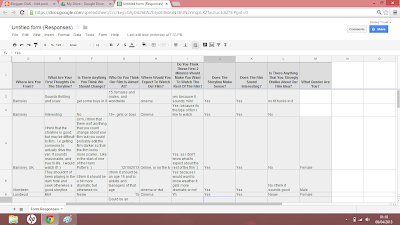 In the feedback sheet we created on what they thought of our 2 minute storyline we discovered that these realistic features appealed to our audience as one person put 'it sounds thrilling and scary', and another also put 'it sounds reasonable, and true to life'. They put this, as our description tells the audience that it is set in a local field, uses 3 normal teenage girls and uses a stalker, this could occur in real life.
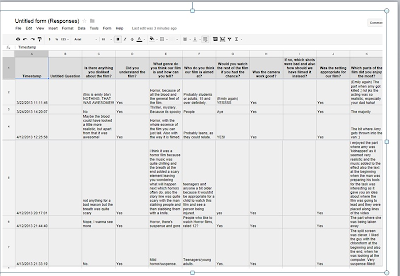
In our second feedback sheet that we created after we had finished our film, people have given good feedback and have commented with things such as that they liked 'the part when Amy was killed' and when 'Amy gets thrown into the van', they also thought the sound effect of the breathing was effective in scaring people.
However they have also given creative criticism of our film on what wasn't so successful and also given us ideas on how to improve. For example 'the blood could have looked a little more realistic' as we had to use fake blood from a shop and also mix our own using food colouring. We could have improved this by making sure the colour of the blood was more realistic coloured and looked better.

Our target audience was aimed at 15-35 year olds, so our film had to include features/conventions of a horror film that would be enjoyable for teenagers as well as adults. Using the BBFC website i researched into the contents of 15 films to see what our film is allowed to include and not include- 'Many horror films are rated 15. At 15 there can be strong threat and menace'
http://www.bbfc.co.uk/what-classification/15
We have also reached out to our audience and used appealing techniques for our audience by making it as realistic as possible, so we didn't use any special effects, we used a local normal location, wore outfits that teenagers would wear, used appropriate props and used conventions that would also scare our audience.
 In the feedback sheet we created on what they thought of our 2 minute storyline we discovered that these realistic features appealed to our audience as one person put 'it sounds thrilling and scary', and another also put 'it sounds reasonable, and true to life'. They put this, as our description tells the audience that it is set in a local field, uses 3 normal teenage girls and uses a stalker, this could occur in real life.

In our second feedback sheet that we created after we had finished our film, people have given good feedback and have commented with things such as that they liked 'the part when Amy was killed' and when 'Amy gets thrown into the van', they also thought the sound effect of the breathing was effective in scaring people.
However they have also given creative criticism of our film on what wasn't so successful and also given us ideas on how to improve. For example 'the blood could have looked a little more realistic' as we had to use fake blood from a shop and also mix our own using food colouring. We could have improved this by making sure the colour of the blood was more realistic coloured and looked better.
Evaluation: 7
Looking back at your preliminary task, what do you feel you have learnt in the progression from it to the full product?
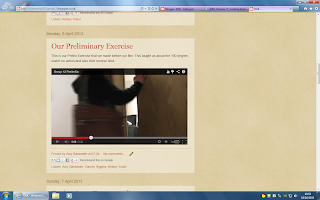 The brief we were working to for our preliminary task was to create a short continuity task that included the 180 degree rule, match on action and shot-reverse-shot. In this task we filmed and edited scenes of a character walking down a corridor, opening the door, walking in and sitting down opposite another character, a short conversation and finally walking out again.
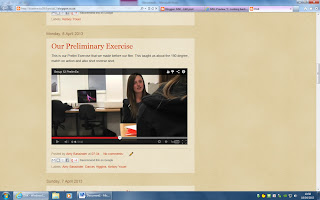 The brief for our main task was to make titles and the opening of a new fiction film that lasts a maximum of 2 minutes.
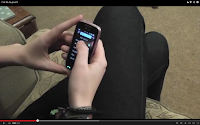
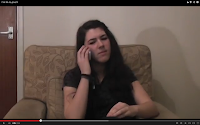 The skills we have learnt in our prelim exercise we have used in our 2 minute film: We used match on action in our prelim exercise for when Kelsey opened the door and then walked through, we also used it in our 2 minute film as shown, as i am holding the phone and then put it to my ear.
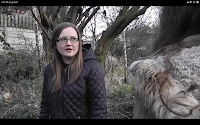
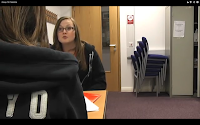 We also used shot-reverse-shot in our preliminary exercise so we also used this in our film, as in our first exercise we used over the shoulder shots when Kelsey and Amy were talking to each other. We then used these shots in scenes in our film to show when conversations and their facial reactions are important such as when Kelsey and I are worried about Amy. This scene also uses the 180 degree rule as the camera didn't go over the line; this makes sure the scene looks right.
 Improvements: We have got better at editing our film, as in the preliminary exercise we couldn't make the match on action flow properly as there were a few jump cuts when the action didn't match correctly. But then in our film we managed to edit it smoothly so the action flowed and we used match on action.
Other methods: We used a split screen when we edited our film so that we used something different and the phone conversation looked like it flowed. We changed the way Kelsey was looking so that it looked like a proper phone conversation and the girls seemed like they were looking/talking to each other.
 The brief we were working to for our preliminary task was to create a short continuity task that included the 180 degree rule, match on action and shot-reverse-shot. In this task we filmed and edited scenes of a character walking down a corridor, opening the door, walking in and sitting down opposite another character, a short conversation and finally walking out again.
 The brief for our main task was to make titles and the opening of a new fiction film that lasts a maximum of 2 minutes.

 The skills we have learnt in our prelim exercise we have used in our 2 minute film: We used match on action in our prelim exercise for when Kelsey opened the door and then walked through, we also used it in our 2 minute film as shown, as i am holding the phone and then put it to my ear.

 We also used shot-reverse-shot in our preliminary exercise so we also used this in our film, as in our first exercise we used over the shoulder shots when Kelsey and Amy were talking to each other. We then used these shots in scenes in our film to show when conversations and their facial reactions are important such as when Kelsey and I are worried about Amy. This scene also uses the 180 degree rule as the camera didn't go over the line; this makes sure the scene looks right.

Other methods: We used a split screen when we edited our film so that we used something different and the phone conversation looked like it flowed. We changed the way Kelsey was looking so that it looked like a proper phone conversation and the girls seemed like they were looking/talking to each other.
Friday, 22 March 2013
Pick Me Up Form
Now that our film is online we have made a response form so that our viewers can tell us what they think.
https://docs.google.com/forms/d/1e3quorfadLCHKPKyQQuqAXh2d0sDHV7lJAKA8GOSTRY/viewform
https://docs.google.com/forms/d/1e3quorfadLCHKPKyQQuqAXh2d0sDHV7lJAKA8GOSTRY/viewform
Friday, 15 March 2013
Progress Report 15/03/13
Time management:
We have now finished our filming and we are undergoing out editing, the blog is now finished as everything that needed to be included has been.
The filming took longer than we thought it would, it took us about three weeks due to weather conditions and timing issues as not all of our group could work at the same time due to commitments.
Next we will be complete our editing and will start paperwork for the evaluation of our film, and also finish our blog as we need to upload our finished film and a few other bits, like our evaluations.
Sunday, 3 March 2013
Analysis Of Phone Booth (First 15 min)

 The film starts with a shot of space satellites, which then moves onto the earth and then begins to zoom in. However as it zooms into earth it fades into some kind of micro chip, rather than looking at towns or cities. As this is not what the audience are expecting, it stands out and so they will notice it. Whilst this is happening there is a non diegetic song added onto the scene with the word ‘operator’ being repeated multiple times. On top of this there is also a walkie-talkie sound effect. All of this together tells the audience that the film will have something to do with phones and so it therefore gives the audience clues to the storyline. The main reason it does this is because each of these things are very noticeable.


After this the camera zooms in and out of random things happening on the streets of New York. At this point the audience are not sure about what/who they should be focusing on. However all of these shots involve phones (for example on this screen shot 'Verizon' is the a company logo for an American phone network). Also there is no diegetic audio at this point (instead there is only non-diegetic music) which also does not help the audience to understand what is happening.

A voice over of a man begins to state facts about phone booths. As the random shots stop we are left with this long shot of a phone booth. The voice over then reveals facts about this particular phone booth rather than general facts. This then signals to the audience that this is the phone booth that they need to focus on and so gives them another clue towards the story-line of the film.

The voice over then says that you (the audience) are about to see the last man to occupy the booth. In this shot there are two men shown in the centre of the shot. Centered characters are always the characters that the audience are supposed to focus on and so this would suggest that either of these two men are who the voice over is talking about. However you can only hear one speaking (the one in the red shirt) and so the audience should understand that he is the one who is being talked about.
 In the next few minutes this man participates in multiple phone calls and every time someone picks the phone up they are shown on screen talking back. This currently does not seem important but later the murderer, on the phone, is not shown and so the audience go from being able to see who the man is calling to being as clueless as he is. This alone helps the audience to empathize with the character due to them being on the same journey.
 Once the man gets into the booth, the next shot is a long shot but from a high angle. This is an odd and random shot because the previous shots of this man have been mostly medium shots. Due to it being an odd shot the audience are more likely to notice it. This shot itself would suggest that someone is watching the man from a high angle.

 Later there is an eye line match from the man's point of view. As this follows his point of view the audience should have realized by this point that he is the main character. Also, the man is searching for the unknown person on the phone just like the audience. This again helps the audience to empathize with him.
The final shot i will discuss is an extreme close up of the mans face. This puts emphasis onto his frustration (his current emotion). The audience can therefore see how he is feeling and so have the chance to empathize with him again.
From analyzing the opening of Phone Booth i have noticed that in order to make our audience empathize with our girl characters, then they need to be on the same journey as them. To do this we could use eye line matches and only reveal things that the girls can see (such as the text message). In our film we are wanting to show the murderer preparing to kill the girl and so in order for us not to reveal too much the the audience we could avoid showing his face. That way neither the audience or our girl characters would be able to recognize him (the murderer).
Another thing i have noticed is the simplicity of the title and I feel that it reveals the majority of the plot. I think that this is both a good and a bad thing. For example i think that the audience would be able to guess what the film is about and so would be likely to be disappointed. However, i also think that it may give away too much of the plot. If the film was to be called something relating to a phone, a phone booth or a phone line/network (but not too obvious) then this would leave a gap in the audiences mind which the film would then need to fill. I therefore think that the title of our film should be something clever which relates to something significant from our film.
Subscribe to:
Posts (Atom)